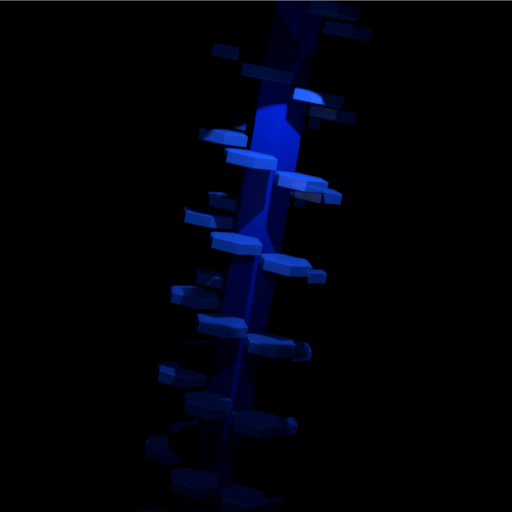

Tiling the world with babylon's Solid Particle System.
Babylon.js’ equivalent of three.js’ InstancedBufferGeometry is, in a way, the Solid Particle System. So the advice of the Babylon.js forum (a great community so far by the way!), I’ve tried playing with that.
The SolidParticleSystem uses a single vertex buffer object, which might be slow compared to a double buffer approach. At least the Khronos Wiki (see “double buffered VBO”) still seems to say this gives a performance advantage. But maybe not, with modern GPUs.
It doesn’t much matter, since ultimately I will need to implement a WebGL 2.0 version of this using Transform Feedback and the flat shader directive that will be more performant than this system can offer.
The following is babylon playground code demonstrating a flexible number of SolidParticleSystems that are each updated constantly, all the particles in one SPS are updated each frame.
If you copy/paste the following code into the Babylon Playground you can view the real-time rendering of this scene and play with the code:
var createScene = function () {

    // This creates a basic Babylon Scene object (non-mesh)
    var scene = new BABYLON.Scene(engine);

    // This creates and positions a free camera (non-mesh)
    var camera = new BABYLON.ArcRotateCamera(
    	"camera1", 0, 0, 10, BABYLON.Vector3.Zero(), scene);
    camera.setPosition(new BABYLON.Vector3(0, 20, -10));
    camera.attachControl(canvas);

    var light = new BABYLON.PointLight("l", camera.position, scene);

    var model = BABYLON.MeshBuilder.CreateCylinder("m", {tessellation: 6}, scene);

    // Note: total particles is (nb * numSPS)
    var nb = 100;
    var numSPS = 25;

    var spsL = [numSPS];

    for(var j = 0; j < numSPS; j++){
        var sps = new BABYLON.SolidParticleSystem('sps_'+j, scene);

        sps.addShape(model, nb);

        var mesh = sps.buildMesh();
        mesh.useVertexColors = true;

        sps.initParticles = function() {
            var tileWidth = 10;
            var patchWidth = 5;
            var x,y,z;
            for (var k = 0; k < nb; k++){
                var par = sps.particles[k];

                // x
                x = 0;
                // position particle in tile
                x += k % tileWidth;
                // position tile in patch
                x += (j % patchWidth)*tileWidth*1.1;
                //x += j*tileWidth*1.1;
                // center patch on origin
                x -= (tileWidth*patchWidth)/2;

                // z
                z = 0;
                // position particle in tile
                z += Math.floor(k/tileWidth)
                // position tile in patch
                z += Math.floor(j/patchWidth)*tileWidth*1.1;
                // center patch on origin
                z -= (tileWidth*patchWidth)/2;
                // hex tile offset
                z += (k % 2) * 0.5;

                y = -1;

                par.position.x = x;
                par.position.z = z;
                par.position.y = y;
            }
        }

        sps.isAlwaysVisible = true;
        sps.computeParticleColor = true;
        sps.initParticles();
        sps.setParticles();

        sps.mesh.freezeNormals();
        sps.mesh.freezeWorldMatrix();

        spsL[j] = sps;
    }

    model.dispose();

    frameNum = 0;

    scene.registerBeforeRender(function() {

        // iterate through list of SPS objects
        iSPS = frameNum % numSPS;

        // update the same SPS object each frame.
        //iSPS = 0;

        for(var i = 0; i < nb; i++){
            var par = spsL[iSPS].particles[i];
            par.position.y = 0.5 + Math.random() * 0.5;
        }
        spsL[iSPS].setParticles(0, nb, true);
        frameNum++;
    })

    return scene;

};